Labor Practices
1. Policy and Basic Approach
1-1. Respect for Human Rights
As a general trading company developing business around the world, Sojitz Group is involved in a wide range of supply chains. One of Sojitz Group’s most important tasks is to work together with suppliers to reduce environmental and societal (human rights) risks within its supply chains.
Sojitz has established the following Sojitz Group Human Rights Policy in order to further ensure that all Group business is conducted in alignment with Sojitz’s Key Sustainability Issue (Materiality) of "Respect for human rights of people involved in our businesses."
The Sojitz Group Human Rights Policy has been approved by the Sojitz Management Committee. Initiatives and policies created in accordance with the Human Rights Policy are reviewed by the Sustainability Committee and Management Committee, and the outcomes of these discussions are reported to the Board of Directors.
Sojitz Group Human Rights Policy
1. Our Commitment To Respect Human Rights
Sojitz Group strives to create value and prosperity by connecting the world with a spirit of integrity. We believe that respect for human rights is an integral foundation for creating Sojitz’s two types of value—"value for Sojitz” and “value for society”—and for meeting the expectations of our stakeholders.
As a general trading company, Sojitz Group buys, sells, and trades goods from all over the world, provides manufacturing and sales services for a wide range of products, plans and coordinates various projects, invests in a multitude of business fields, and conducts financial activities. In undertaking these business activities, Sojitz recognizes its responsibility to not cause or contribute to adverse impacts on human rights and work to prevent or mitigate any adverse impacts directly linked to company operations in order to fulfill its obligation to uphold human rights.
2. Scope of Policy
This policy applies to all executives and employees of Sojitz Corporation and Sojitz Group companies. Sojitz also requires executives and employees of its equity-method affiliates to implement human rights-related initiatives in line with the policy.
In addition, Sojitz Group expects the full understanding and support of its suppliers, business partners, and other associated parties regarding this policy.
3. Honoring International Human Rights Standards
We are committed to respecting human rights as set out in the International Bill of Human Rights and the International Labour Organization’s (ILO) Declaration on Fundamental Principles and Rights at Work, and to carrying out our business in accordance with the United Nations Guiding Principles on Business and Human Rights.
Sojitz Group shall comply with local laws and regulations in conducting its business activities. In the event that laws or regulations in a country conflict with the international human rights standards, Sojitz will seek ways to honor the international human rights standards.
4. Human Rights in Our Business Operations
In accordance with international human rights standards and the Sojitz Group Statement, Sojitz Group prohibits discrimination and promotes respect for diversity, including with respect to race, nationality, ethnic origin, beliefs, sex, social status, religion, age, mental and physical disability, sexual orientation, and gender identity. Sojitz is committed to the prohibition of child and forced labor and the prevention of corruption. Sojitz provides a safe labor environment and works to ensure responsible labor practices, including the observance of appropriate working time. Sojitz aims to promote the payment of a fair and equitable wage that meets or exceeds living wage standards. Sojitz Group supports freedom of association and the right to collective bargaining.
5. Conducting Human Rights Due Diligence
Sojitz Group is committed to assessing actual and potential adverse impacts on the human rights of its stakeholders in accordance with the United Nations Guiding Principles on Business and Human Rights. Sojitz will identify, assess, prevent, and mitigate adverse impacts of its business by conducting human rights due diligence.
6. Stakeholder Engagement
Sojitz Group will continue to develop and enhance the initiatives outlined in this policy through ongoing dialogue and discussion with relevant stakeholders.
7. Remediation and Remedy
Sojitz Group will take the appropriate steps for remediation and remedy in the event that the company’s business activities are found to be causing an adverse impact on human rights or contributing to a human rights violation through its supply chains or other business relationship.
In addition, Sojitz Group has established a grievance mechanism for directly receiving inquiries from internal and external stakeholders of the company regarding any adverse impacts on human rights associated with Group business activities.
8. Education and Training Programs
Sojitz Group conducts education and training programs for Group executives and employees in order to ensure their understanding and effective implementation of this policy.
9. Information Disclosure
Sojitz Group will disclose information regarding its human rights initiatives and progress on these initiatives in a timely and appropriate manner.
- Sojitz Group refers to Sojitz Corporation and its consolidated subsidiaries.
- For further information on Sojitz’s response concerning reports of a material policy breach within the supply chains, see the Sojitz Group CSR Action Guidelines for Supply Chains.
Established in June 2017
Revised in August 2023
Revised in April 2026
Policies on Specific Issues
Sojitz Group identifies the business areas that pose high human rights risks and conducts analysis to determine which portions of its supply chains are most susceptible to these risks. Sojitz has established the following policies regarding its approach to specific issues that involve particularly high risk of human rights violations.
Rights of Children
Sojitz Group upholds the Convention on the Rights of the Child and the Children’s Rights and Business Principles. The Group does not tolerate any form of child labor and strives to ensure respect for the rights of children throughout its business activities.
Rights of Indigenous Peoples
When undertaking business activities in areas in which indigenous peoples reside, Sojitz Group will acknowledge the unique culture and history of indigenous peoples and show consideration for their rights as set out in both local and national laws as well as in international standards such as the United Nations Declaration on the Rights of Indigenous Peoples and the ILO Convention No. 169.
Use of Security Companies
In conducting global business activities, Sojitz Group may use security companies to ensure the safety of its business operations. The Group recognizes the potential risk of human rights violations posed by the misuse of weapons in security operations. Sojitz adheres to the laws and regulations of each country and upholds relevant international standards and agreements, such as the Voluntary Principles on Security and Human Rights (VPSHR).
1-2. Harassment Prevention under Sojitz Group’s Compliance Program
As required by the Equal Employment Opportunity Act, Sojitz has established a system for maintaining a positive work environment and preventing all types of harassment, including power harassment, sexual harassment, and harassment related to pregnancy, childbirth, and childcare and family care leave. Sojitz also conducts trainings, including manager training on handling reports or incidents of bullying or harassment, and takes various steps to implement this system. Based on action plans formulated by the Compliance Committee, Sojitz will continue to provide Group companies with counsel on methods for preventing compliance issues from reoccurring, and offers assistance and guidance on implementing the Sojitz Group Code of Conduct and Ethics.
1-3. Labor Standards and Work Environments
■ Basic Approach to Human Resources
Sojitz Group’s growth depends on its employees. We want to make Sojitz a rewarding company to work for and to create fulfilling workplace environments that support a diversity of people and work styles. Accordingly, we have established human resource systems and workplace environments that enable all employees to utilize their talents.
1. Policy on Work Style Reforms and Productivity Enhancement
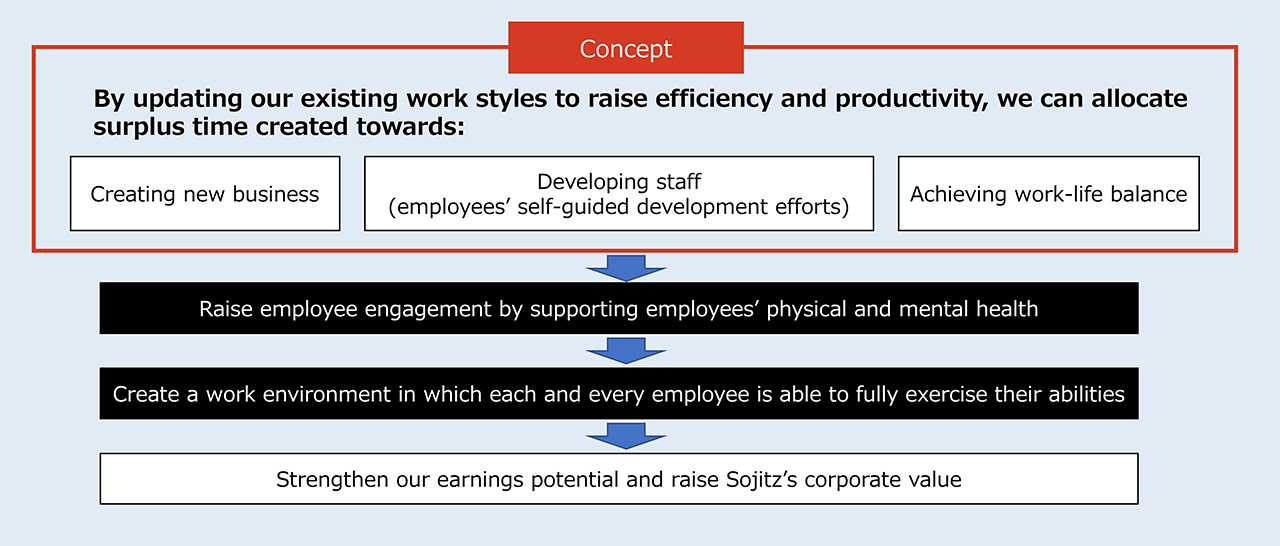
At Sojitz, we believe that maximizing the capabilities of our employees is essential to driving sustainable growth. We have positioned work style reforms as a major policy initiative of Medium-term Management Plan 2020, and have strived to improve efficiency and productivity in our operations.
2. Policy on Employee and Labor Relations
Sojitz respects workers’ rights, including the right to free association and the right to collective bargaining. We continuously monitor relations between the labor union and management, maintaining constant dialogue with both parties to confirm whether these rights are appropriately safeguarded.
2. Goals and Targets
2-1. Policy on Work Style Reforms and Productivity Enhancement
| FY2026 Target | All employees use 17 days or more of paid leave throughout the year (One day per month of annual leave and five days of summer holiday leave) |
|---|---|
| No employees working over 80 hours of overtime per month |
* The overtime limit of 80 hours per month is calculated based on Sojitz’s prescribed workday length of 7 hours and 15 minutes. This limit is equivalent to approximately 65 hours per month when calculated using Japan’s statutory workday length of 8 hours.
3. Systems
| Head of Human Capital | Atsuhiko Tsukamoto (COO, Human Capital Department) |
|---|---|
| Secretariat | Human Capital Department 1 Important matters such as human resource systems and strategies are presented for discussion to the Management Committee. |
4. Initiatives
4-1. Addressing Modern Slavery and Human Trafficking
Sojitz is committed to preventing modern slavery and human trafficking in its supply chains and throughout its business activities. Sojitz creates its human rights policies in accordance with international human rights standards and the Sojitz Group Statement, and strives to reflect these policies in its business activities. Sojitz complies with legal requirements in countries with specific laws for preventing modern slavery and human trafficking such as the UK and Australia. Sojitz also conducts trainings and implements other measures to raise employee awareness of human rights issues throughout Sojitz Group.
4-2. Labor Standards and Work Environments
1. Work Style Reforms and Productivity Enhancement
Sojitz is taking a number of approaches to improve the physical and mental well-being of its employees and to raise productivity. We have implemented policies to reduce overtime and increase use of annual leave as well as adopted a “super flex” system that enables flexible working styles that fit each employee’s individual work requirements. In addition, we are implementing telework throughout the company and introduced new IT tools to increase efficiency. In response to the labor reforms enacted in Japan in April 2019 that set upper limits on overtime and require employees to use five days of paid annual leave, we have set our own work reform targets, improved our timesheet system to better monitor overtime hours and annual leave, and taken measures to inform staff throughout the company about the contents of these labor reforms by creating and disseminating e-learning materials.
Curtailing Long Working Hours
We are promoting a reduction in long working hours by fundamentally prohibiting work after 8:00 p.m., and making it a goal that no employee should work more than 80 hours* of overtime per month. As a result, the number of employees who worked more than 80 hours of average monthly overtime drastically decreased from 69 in FY2018 to 19 in FY2024.
- The overtime limit of 80 hours per month is calculated based on Sojitz’s prescribed workday length of 7 hours and 15 minutes. This limit is equivalent to approximately 65 hours per month when calculated using Japan’s statutory workday length of 8 hours.
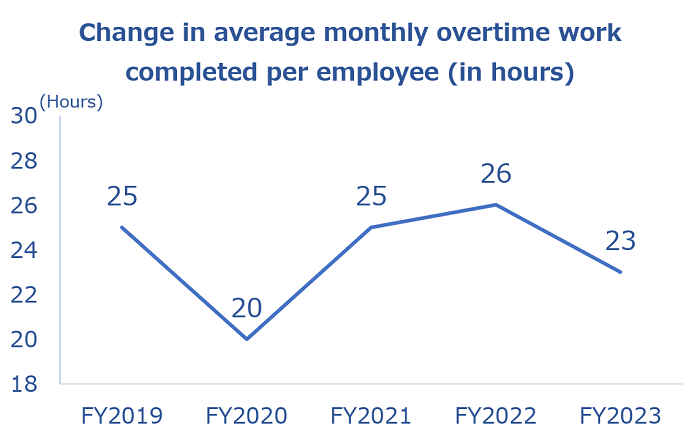
In addition, Sojitz positioned workstyle reforms as a key measure of Medium-term Management Plan 2020, and is continuing efforts to improve work efficiency and productivity through the reduction of overtime hours. Average monthly employee overtime hours for each fiscal year are detailed below.
hours/month
| FY2020 | FY2021 | FY2022 | FY2023 | FY2024 |
|---|---|---|---|---|
| 20 | 25 | 26 | 23 | 24 |
Improving Timesheet Management
We have revamped our computerized timesheet management system, which records working time based on an employee’s computer usage time, so that supervisors can more efficiently monitor each employee’s daily overtime and receive automatic alerts from the system when an employee is in danger of exceeding the overtime limit for the month. Also, the amount of leave that employees use is now visible to their managers, making it easier for managers to communicate with staff on how to strategically manage work and schedule leave. Furthermore, when overtime work is unavoidable, such as when employees are subjected to heavy workloads during busy seasons, and their working time surpasses a designated limit, the Human Resources Department will contact the supervising manager to offer guidance for improvement, such as through better allotment of work responsibilities among staff or ways to increase efficiency.
Encouraging the Use of Paid Leave
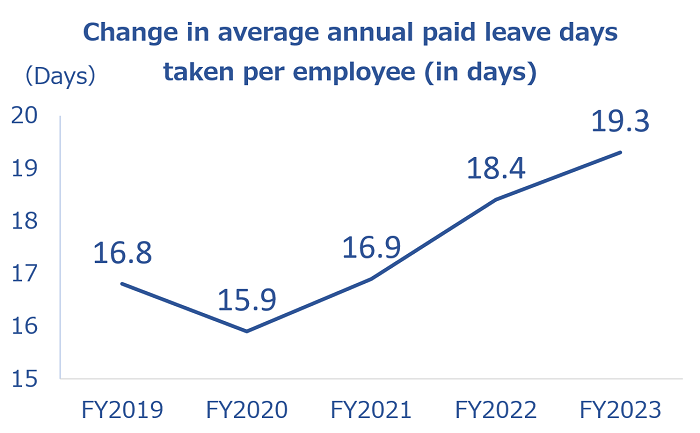
Sojitz offers 20 days of paid annual leave to employees from the following fiscal year after they enter the company, provided that they achieved an attendance rate of at least 80% in the preceding fiscal year. In addition, employees are given 5 days of summer leave, for a total of 25 days of paid leave per year. In FY2024, we achieved our target of employees using 17 days or more of annual leave (19.4 days). In FY2025, we will continue to promote the usage of 17 days or more (a usage rate of 68%) as an ongoing target. In addition to implementing work sharing in each Group organization to encourage employees to use leave, we have made use of annual leave a component of organization appraisals and are continuing to pursue efforts aimed at further raising leave usage among employees.
Special Leave for Long-term Employees
When an employee reaches their 10th, 20th, and 30th year in the company, they are awarded an extra five days of leave, and they are eligible to use this leave in conjunction with either paid annual leave or summer leave to take extended leave for a period of two weeks or less. This system affords people the time away from the office to travel to distant or hard-to-reach destinations which would otherwise be difficult to visit using the standard number of annual leave days, thus allowing them a chance to rejuvenate both physically and mentally.
Addition of Special Leave (Family Support Leave)
For employees who have already used 12 or more days of paid annual leave, we offer five days of leave for the purposes of family support (such as for accompanying a spouse during labor, attending school functions, caring for parents, etc.) to make it easier for employees to use annual leave for household circumstances.
Allowing Employees to Choose When and Where They Work
Core working time has been replaced by a “super flex”* system. This new system allows employees to choose their own work times based on the specific circumstances within their organization, such as conducting business with overseas regions in different time zones. Additionally, as a workstyle reform, a telework system was introduced in January 2020 after undergoing a company-wide trial beginning in FY2018. As a result, we were able to respond quickly and encourage employees to utilize the flex time system or work from home in February 2020 to prevent the spread of COVID-19. Under the state of emergency, we allowed all employees to work from home in order to minimize risk and maintain business continuity. We will continue to utilize the telework system to adjust to new work styles.
- As of November 2017, we have eliminated core time and made it possible for employees to work between the hours of 7:00 a.m. and 8:00 p.m. as best suits their personal circumstances. Furthermore, by encouraging employees to leave at least 10 hours between when they finish working for the night and start work the following day, we make consideration for our employees’ health a priority as they go about their work duties.
Building an Office that Elevates Individual and Organizational Capabilities
As part of plans to reorganize the workspaces in our Tokyo headquarters to accommodate more employees, we reviewed responses to the engagement survey sent to headquarters staff as well as the results of a separate employee survey with the aim of creating a new office concept adapted to employee workstyles. We are now reflecting this new concept in the design and facilities of Sojitz workspaces. Going forward, we will continue to offer ample spaces for communication to elevate employee productivity and provide individual booths to facilitate concentration and enhance work quality.
Work Optimization
Adoption of Robotic Process Automation (RPA)
Sojitz is promoting the use of IT tools to increase work efficiency and is making a company-wide shift to high value-added work. In 2018, the company introduced robotic process automation (RPA), and automating routine tasks has led to a reduction of roughly 39,000 hours of work time across the company (as of the end of March 2025). In November 2022, Sojitz launched a low-code tool development platform, the Citizen Development Program, which allows employees to develop and utilize apps for business operations. Through the program, 646 employees have received developer certification and developed 174 apps. These apps have enabled employees to reduce their workload by approximately 37,000 hours (as of May 2025). Sojitz will continue to utilize a wide range of digital technologies to increase work efficiency moving forward.
Leveraging Generative AI
In addition, Sojitz is actively promoting the use of generative AI as a tool to improve operational efficiency. In February 2024, we launched Sojitz AI Chat at our Tokyo headquarters, a generative AI tool that enables the safe and secure use of internal company information. We have also appointed Generative AI Leaders in each department to accelerate the adoption of generative AI and promote the effective use of Sojitz AI Chat in daily operations. As a result of these efforts, over 70% of employees at Sojitz headquarters were using Sojitz AI Chat by the end of March 2025, contributing to enhanced efficiency and productivity across the organization.
Digitization of Contract and Approval Processes
Additionally, Sojitz adopted a new company-wide electronic contract system in 2021. The company also digitized the internal process for approving accounting-related documents, and this shift has led to a reduction of a total of 74,000 work hours (as of March 2025). A large portion of Sojitz’s internal applications and forms have already been digitized, and the company will continue to expand digitization moving forward.
As a result of these initiatives, we have observed a shift in employee awareness through our company-wide engagement surveys. Each year, an increasing number of employees express agreement with the statement that "Sojitz is addressing digital transformation as a company-wide priority." Sojitz remains committed to enhancing operational efficiency by leveraging a wide range of digital technologies.
Sojitz is also rethinking how to conduct meetings, which often constitute large portions of the workday, based on the results of employee engagement surveys. For example, we have made a rule requiring a 40-minute time limit for meetings in order to encourage employees to reach a conclusion and decide on the next course of action within that timeframe. This rule is posted as a message from the Human Resource Department’s general manager in all the meeting rooms in the Tokyo head office and the Kansai office.
2. Employee and Labor Relations
Sojitz Labor Union
The Sojitz Labor Union was established in 2005 under a charter which includes a union shop clause. As of the end of FY2024, the union comprises 1,576 employees, and Sojitz’s unionization rate is 59%. The union aims to create prosperity for the company, improve the economic and social standing of union members, and pursue greater benefits for company employees. The organization has a number of initiatives designed to improve communication between employees and has succeeded in creating a favorable relationship between the union and Sojitz management by ensuring respect for each side’s position, conducting discussions in good faith, and sharing information as necessary.
Cooperation with the Labor Union
The Sojitz Labor Union and Sojitz management discuss issues including the human resource system, salary (both in Japan and overseas), bonuses, severance pay, pensions, employee health and safety, working hours, training, and career development. Systems and policies are only implemented upon agreement by both parties. The two organizations also discuss any major reorganization which would impact employees’ working conditions. At any time, employees can confirm the content of these discussions on the company intranet.
Dialogue between the Labor Union and Management
To ensure that the company’s management policies and vision are well understood and to share proposals from the labor union, Sojitz regularly holds briefings between the union and management. Sojitz also works to construct systems which create a motivating work environment that challenges employees to pursue professional growth and which helps employees to achieve work-life balance.
Inspiring Communication between the Company and Employees and their Families
-
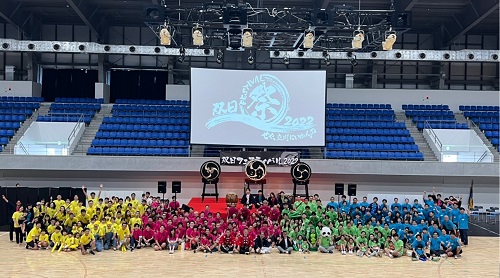
The labor union and Sojitz management jointly organized the "Sojitz Festival" in Tokyo in June 2022 and "Sojitz Family Day" in August 2024. In addition, the company holds a softball and bowling tournament and smaller events such as seminars on aroma therapy, cooking classes, and Pilates classes. Sojitz works to create a stronger sense of solidarity between staff by continuing to hold events which help inspire multilateral communication, not only with employees, but with their families as well.
-
A Message from the Sojitz Labor Union
-
The Sojitz Labor Union believes that employee and company growth are both made possible when each employee takes pride in their work at Sojitz, feels the value of their efforts, and exercises their full potential. We are striving to create a work environment which enables each employee to think proactively and take on new challenges. While the values held by union members vary greatly from person to person, we at Sojitz Labor Union aim to represent all members and advise the company through extensive dialogue with management. The union aims to bring employees and management together based on mutual trust in order to build the future of Sojitz.
-
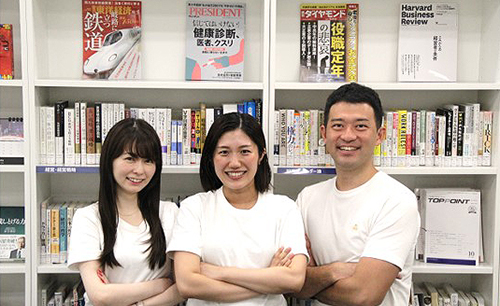
Full-time members of the Sojitz Labor Union
3. Facilities to Promote Communication
We have furnished all workspaces with equipment designed to inspire multilateral, cross-organizational communication between employees. Sojitz’s in-house café (S’Café) is kept open after working hours for an informal happy hour which allows employees from all age groups and a wide variety of organizations to come together and enjoy an open and relaxed atmosphere.
S’Café
We operate several S’Cafés within Tokyo HQ and the Sojitz branch offices in Japan that serve as social areas. The S’Cafés provide a place to relax and communicate, and employees make use of these facilities to take breaks throughout the workday, enjoy lunch, or hold a casual meeting.
Dormitories
Sojitz seeks to ensure that its dormitories are spaces where residents can freely interact and communicate. The men’s dormitories (including in Koto, Tokyo) and the women’s dormitory (Shibuya, Tokyo) feature shared kitchens, fitness rooms, and lounges. These facilities foster open communication between residents. Sojitz also holds events to strengthen ties between each of the dormitories and with local communities, including social events for dormitory residents and participation in local community events.
5. Performance
5-1. Use of Annual Paid Leave
■ Change in average annual paid leave days taken per employee (in days)
| FY2019 | FY2020 | FY2021 | FY2022 | FY2023 | FY2024 |
|---|---|---|---|---|---|
| 16.8 | 15.9 | 16.9 | 18.4 | 19.3 | 19.4 |
Read more: