
Climate Change
1. Policy and Basic Approach
Sojitz Group has established its policies and targets to fulfill its commitment to contributing to the realization of a decarbonized society, as set forth in Sojitz’s long-term sustainability vision for 2050, the “Sustainability Challenge” and has been promoting initiatives based on these policies and targets.
In response to changes in the external environment surrounding decarbonization and ESG, as well as changes in the Group’s business portfolio, Sojitz has set a new interim target for 2035 toward achieving net zero by 2050, in addition to the existing 2030 target. At the same time, in March 2026, Sojitz revised its decarbonization policy to further promote not only the reduction of its own GHG emissions but also the creation of avoided emissions through its business activities.
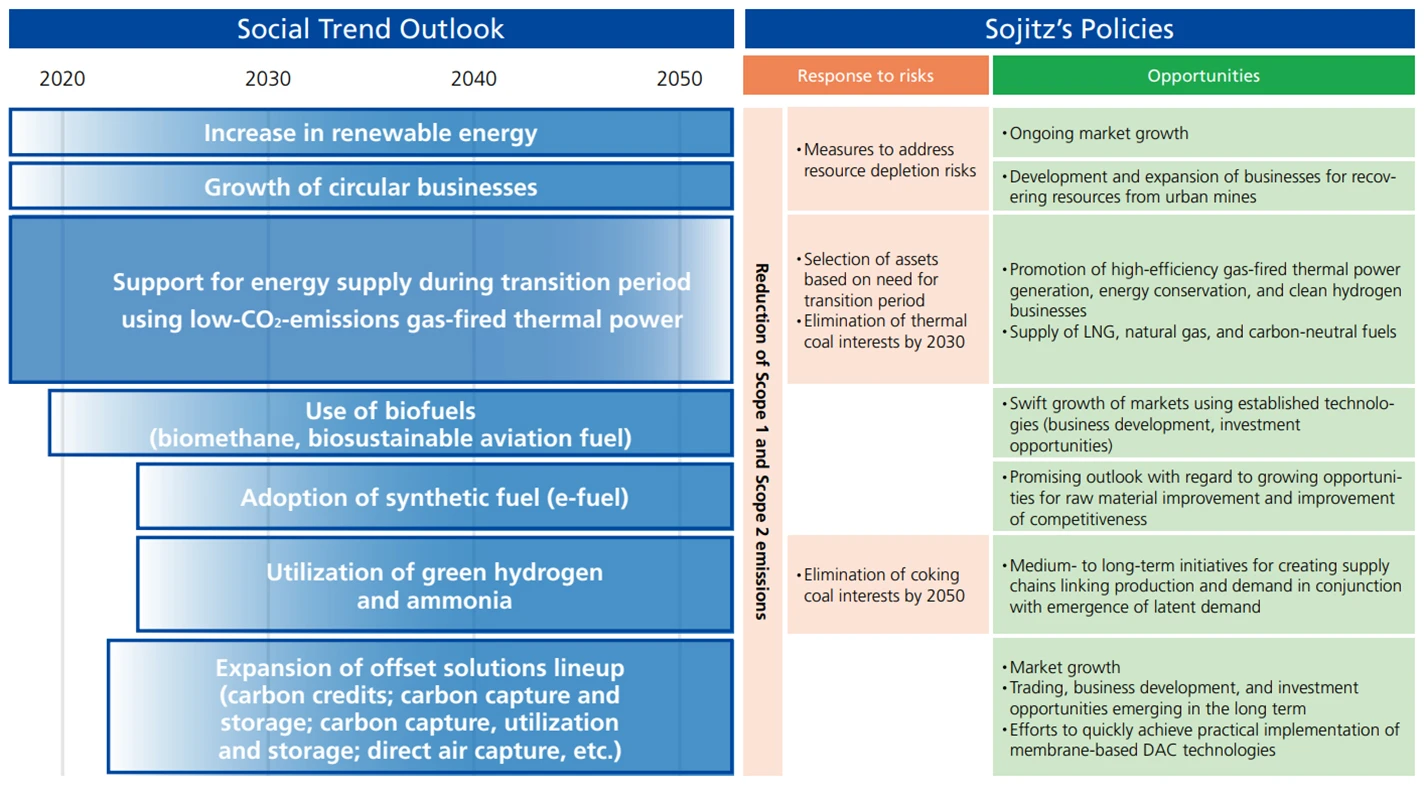
Sojitz has developed a decarbonization roadmap to anticipate this transition, which serves as the foundation of our climate strategy. The roadmap systematically identifies potential opportunities in decarbonization-related fields, taking into account technological innovation, the pace of real-world implementation, and the evolving business environment at each stage. The targets are set, based on this framework.
Sojitz advances the reduction of its GHG emissions from its business activities (Scope 1 and Scope 2). At the same time, it identifies and analyzes GHG emissions across its supply chain (Scope 3). Areas with high Scope 3 emissions are recognized both as business risks subject to increasing decarbonization pressure and as opportunities to drive emissions reductions across society. Guided by the belief that business creation leveraging Sojitz’s unique network and cross-business collaboration is essential to contributing to a decarbonized society, Sojitz seeks to deliver avoided emissions through its businesses.
To date, Sojitz has enhanced its business foundation by transforming the resolution of social challenges through its business activities into a competitive advantage.
Leveraging this experience, Sojitz will continue to create new value that supports the transition to a decarbonized society, showcasing its distinctive contribution through the integration of initiatives that realize emissions reductions and drive progress beyond conventional frameworks.
<Decarbonization Roadmap>
2. Goals and Targets
Scope 1・Scope 2 Targets
2030 Target
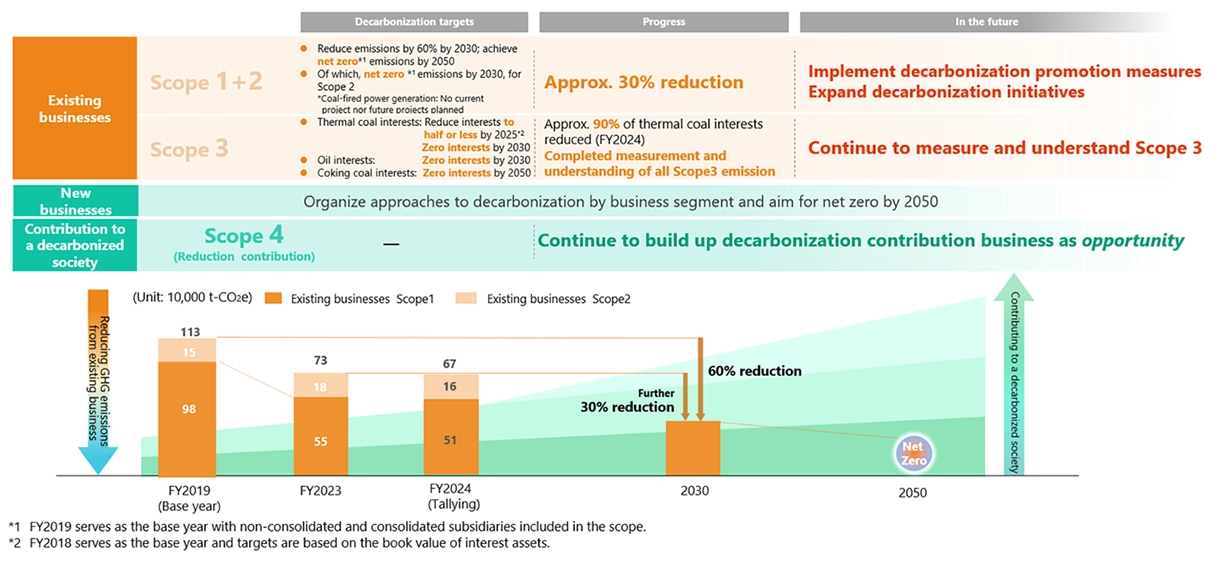
For businesses in operation as of FY2019, Sojitz aims to reduce energy-related CO2 emissions by 60% by 2030 compared with FY2019 levels, including achieving net-zero for Scope 2.
2035 Target
For businesses in operation as of FY2024, Sojitz aims to reduce total GHG emissions by 40% by FY2035 compared with FY2024 levels, including achieving net impact zero* for Scope 2. For businesses thereafter, Sojitz aims to achieve net zero by 2050.
* Net impact zero means a concept whereby Sojitz’s own emissions are reduced to zero after deducting carbon removals and offsets, as well as avoided emissions achieved through its businesses.
| Scope1・Scope2 |
|
|---|---|
| Coal-fired power generation | Sojitz currently has no coal-fired power generation assets and does not plan to acquire any in the future. |
Scope of reporting: These targets apply to Sojitz Corporation (non-consolidated), all consolidated subsidiaries in Japan and overseas, and unincorporated joint ventures subject to reporting under Sojitz’s management control approach.
*1 Energy-related CO2 emissions, with FY2019 as the base year.
*2 GHG emissions, with FY2024 as the base year.
Scope 3 Targets (Natural Resource Interests)
Scope 3 refers primarily to GHG emissions generated throughout the supply chain. Trading companies are involved in extensive supply chains ranging from upstream to downstream. As of FY2019, if all of Sojitz’s resource interests were combusted, the resulting GHG emissions would amount to approximately 200 million tons, far exceeding the approximately 1 million tons of GHG emissions generated from the Sojitz Group’s own direct energy use (Scope 1・Scope 2).
In recognition of the heightened social responsibility associated with resource interests, we have set out the following policies and targets since 2019.
Targets for Resource Interests Businesses
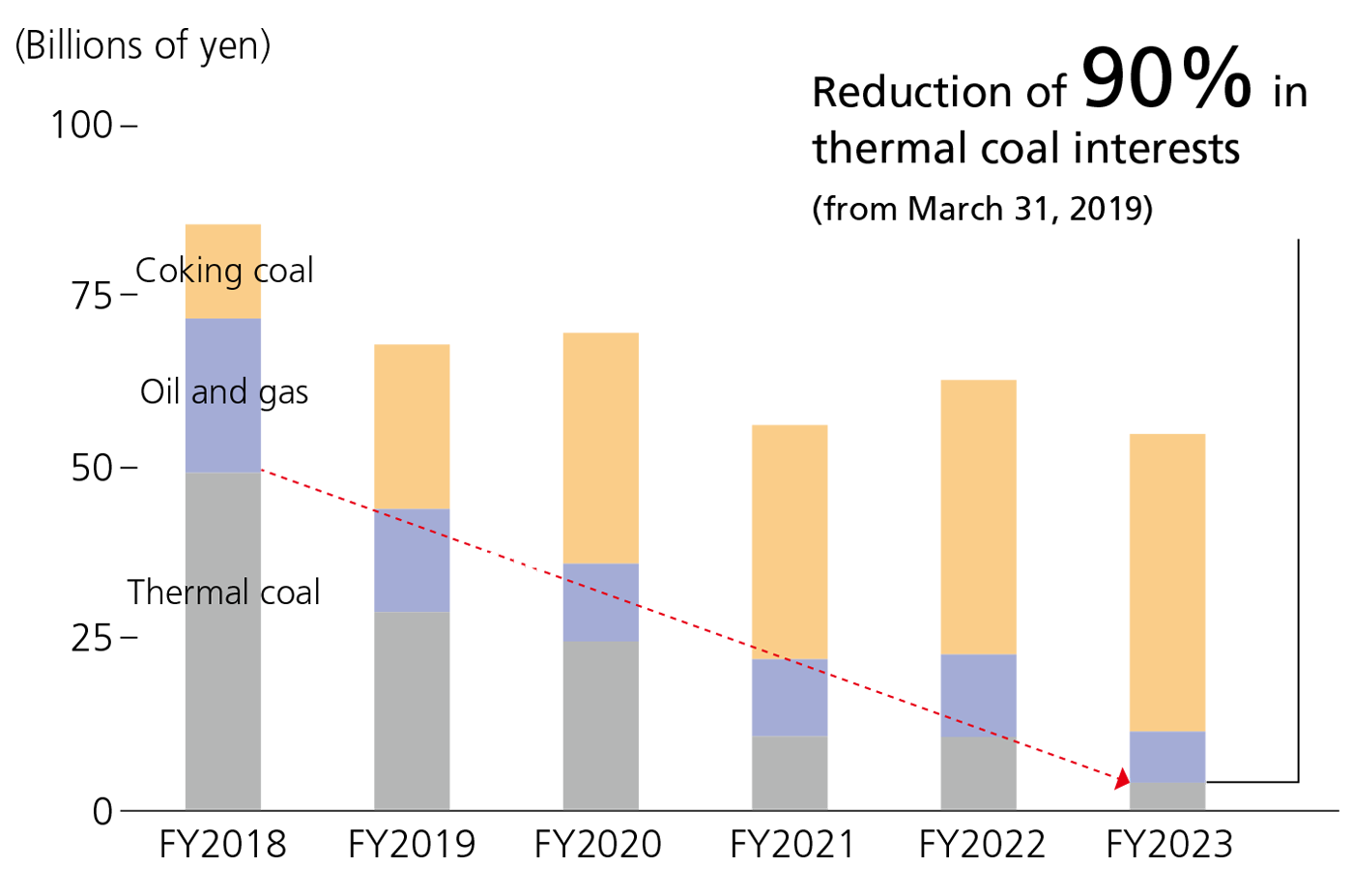
| Thermal coal interests | Reduce to half or less by 2025; zero by 2030 *3 |
|---|---|
| Oil interests | Zero by 2030 |
| Coking coal interests | Zero by 2050 |
*3 Based on the book value of asset holdings in resource interests, with FY2018 as the base year.
2-1. Progress
Progress Toward the 2030 Target
Scope 1 and Scope 2 : For businesses in operation as of FY2019, emissions have been reduced by 40% compared with FY2019 levels as of March 2026, against the target of a 60% reduction by 2030.
Scope 3 (thermal coal interests) : Against the targets of reducing to half or less by 2025 and to zero by 2030, reductions of 90% have been achieved as of March 2026.
Reduction of Emission in Resource Interests:
Progress toward the 2035 targets will be disclosed starting with results for the fiscal year ending March 2027.
3. Response to Decarbonization
3-1. Reduction Measures for Scope1・Scope2 Emissions
To reduce Scope 1 and Scope 2 emissions, Sojitz is formulating sustainable reduction measures with a view to future technological innovation.
- First, Sojitz will pursue energy conservation and efficiency improvements.
- Next, Sojitz will implement emissions reductions through a transition to renewable energy.
- Over the longer term, Sojitz will consider switching to clean fuels, such as hydrogen, ammonia, and synthetic fuels.
- Furthermore, Sojitz aims to optimize its business portfolio, incorporating decarbonization considerations.
- For residual GHG emissions, Sojitz will consider measures including offsets through certificates as well as removals through forestry initiatives and direct air capture (DAC) projects, while maintaining a policy of minimizing reliance on such measures to the greatest extent possible.
Sojitz has introduced the Implementation of decarbonization initiatives to promote decarbonization efforts at its operating companies.
For investment and financing projects, the submitting department is required to complete an “Environmental and Social Risk Checklist.” Based on this checklist, the department also conducts due diligence on environmental and social risks, including climate change, human rights, and biodiversity, and ensures that appropriate mitigation measures are identified and properly addressed.
3-2. Measuring and Tracking Scope3 Emissions
Scope 3 refers primarily to GHG emissions generated throughout the supply chain. However, as trading companies are involved in extensive supply chains from upstream to downstream, it is difficult to accurately and comprehensively grasp all such emissions.
Accordingly, Sojitz identifies business areas that have a significant impact on its growth and business performance, as well as on society, and has conducted measurement and analysis starting with those areas.
As a first step, Sojitz Group has focused on its coal interests. If all of the coal interests (thermal coal and coking coal) held by the Company as of 2019 were burned, the resulting CO₂ emissions would amount to approximately 200 million tons. Given the extremely large potential volume of emissions, Sojitz has established a policy to reduce its interests in thermal coal used for power generation—which can already be substituted with renewable energy—to zero by 2030.
At the same time, Sojitz has set a policy to reduce its interests in coking coal, which is used as a reductant in steel production, to zero by 2050, assuming that alternative reductants such as hydrogen and ammonia will become widespread from the 2040s onward.
| Approach |
|
|---|---|
| Policy(*) |
|
| Action |
|
3-3. Analysis of Scope3 and avoided Emissions across the Supply Chain
Sojitz organizes an overview of its Scope 3 emissions and corresponding avoided emissions opportunities by using a matrix in which the horizontal axis represents industries with high GHG emissions in which the Group is involved, and the vertical axis represents each stage of the supply chain. Based on this framework, Sojitz analyzes and identifies risks and opportunities in each area both qualitatively and quantitatively.
Risks (Scope 3):
Areas with higher GHG emissions are shown in darker shades of orange. Such areas are generally more exposed to pressures to reduce GHG emissions and to the risk of substitution.
Opportunities (avoided emissions):
The bottom row represents opportunities for new substitute businesses, which Sojitz will build up and quantify as avoided emissions.
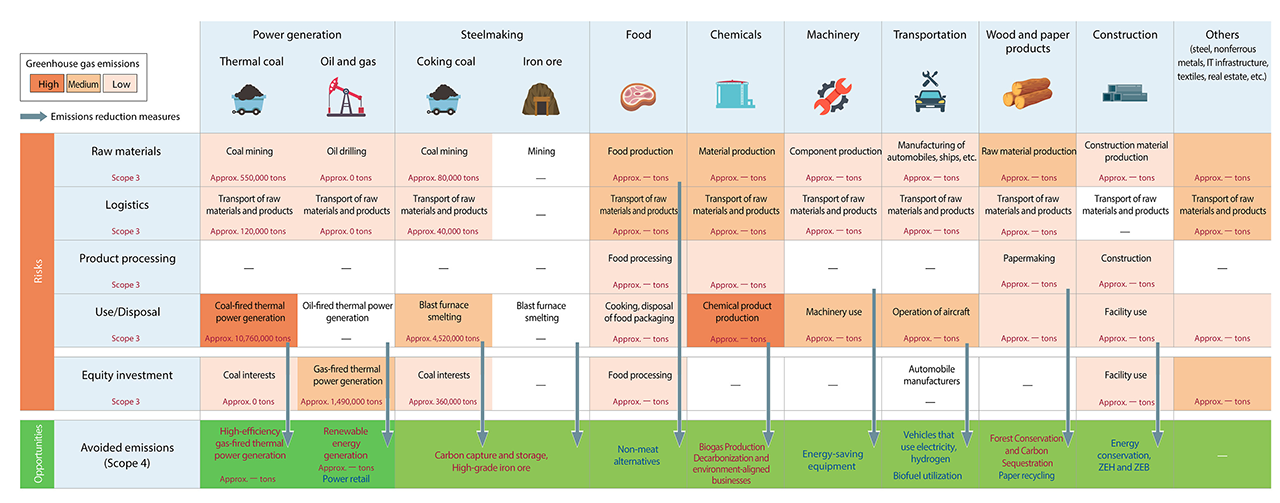
Direct Contribution : Products and services that directly generate emission reduction benefits
Indirect Contribution: Products and services that generate emission reduction benefits through their provision
3-4. Opportunities
3-4-1. Opportunities under Avoided Emissions
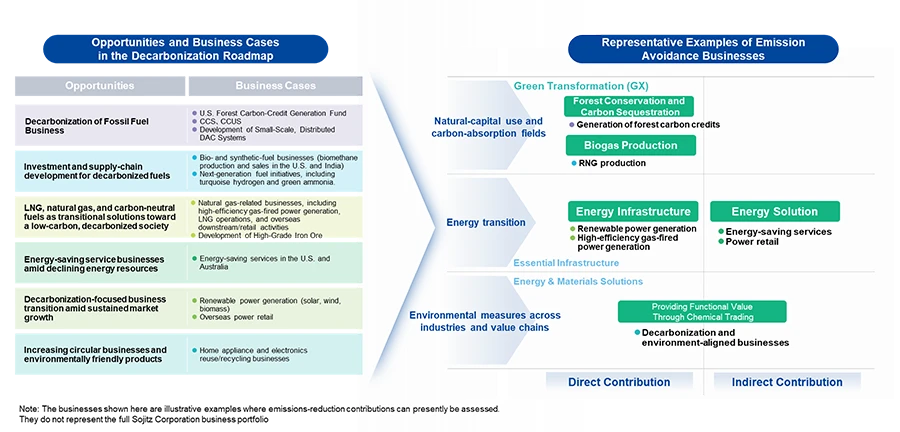
Sojitz Group regards Scope 3 not only as a business risk, but also as an opportunity to create new businesses through avoided emissions across the entire supply chain, and promotes initiatives linked to the Company’s growth. Through these initiatives, Sojitz expands avoided emissions through its business activities.
| Approach |
|
|---|---|
| Action |
|
<Avoided Emissions>
Avoided emissions for the following businesses in FY2025 are shown below. In addition to renewable power generation and high-efficiency gas-fired power generation, which have previously been included in the calculation scope, electricity retail businesses in Europe and Australia have newly been added, reflecting the expansion of the energy solutions business. Sojitz will continue to promote these initiatives and expand its avoided emissions.
| Emission Avoidance Business | Avoided Emissions(10,000t-CO2e) |
|---|---|
| Renewable Power Generation *1 *2 | 76 |
| High-efficiency Gas-fired Power Generation *2 | 177 |
| Electricity Retail *3 | 24 |
*1 Renewable power generation includes solar, wind and biomass power generation.
*2 Direct Contribution: Products and services that directly generate emission reduction benefits
*3 Indirect Contribution: Products and services that generate emission reduction benefits through their provision
<Calculation Method>
Emission factor: Based on the CO2 emission factor (CO2 emissions per kWh from electricity generation) published by the International Energy Agency (IEA).
For further information on the Electricity Retail business, please refer to:
Sojitz Enters the Electricity Retail Business in Ireland|News Room|Sojitz Corporation
Sojitz Acquires Electricity Retail Business in Australia|News Room|Sojitz Corporation
*Approach To Our Power Generation Business
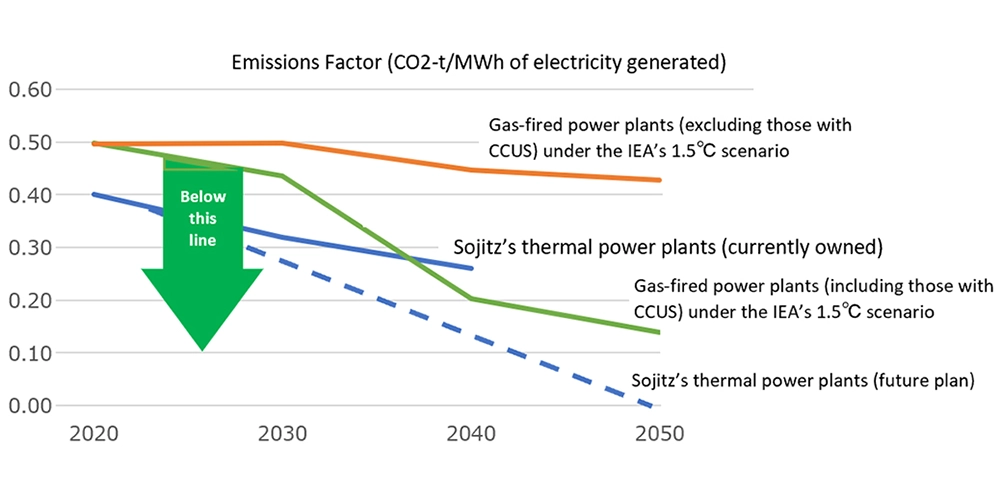
Sojitz will limit CO2 emissions efficiency to below the level required by the 1.5℃ scenario.
| Approach |
|
|---|
-
*<Limiting Our Emissions Factor>
The emissions factor is the amount of CO2 per amount of electricity generated. Formula: Emissions factor = CO2 emission quantity / electricity generated.
The green line below shows the decreasing emissions factor requirement under the 1.5℃ scenario over time. Sojitz will keep the value of its own emissions factor below the requirements of the 1.5℃ scenario.
-
3-4-2. Initiatives and Case Studies
For details on our initiatives, please see:
4. Environmental Data
For our environmental data, please see:
5. Endorsement of TCFD
-

-
Sojitz Group is actively working to disclose information and improve transparency by utilizing the TCFD* framework regarding risks and opportunities related to climate change.
*In August 2018, Sojitz declared its endorsement of the final recommendations of the TCFD (Task Force on Climate-related Financial Disclosures).
For details on risk management and the sustainability promotion framework, please refer to our TCFD disclosures.