
Last
JPY
JPY
(%)
Securities Code : 2768
Last
JPY
JPY
(%)
(Real Time)
JPY
%
BN JPY
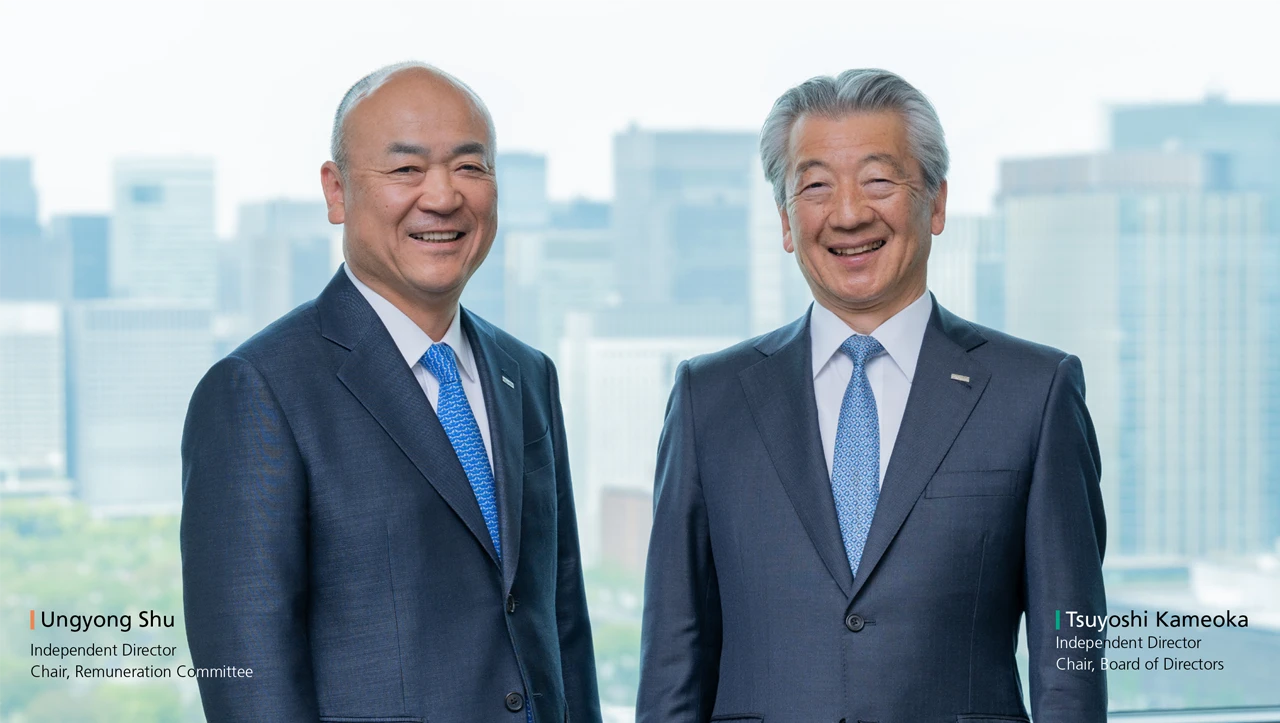
Sojitz is accelerating the transformation of its businesses and organizations in pursuit of its goal of doubled corporate value. Now, with two years having passed since Sojitz’s transition to the company with audit and supervisory committee structure, as described in the Companies Act of Japan, we are witnessing clear changes in the speed of management and in the approach toward decision-making. The following discussion chronicles a conversation between independent directors Tsuyoshi Kameoka and Kazuhiko Takeda in which they delve into their thoughts on the progress of Sojitz’s transformation efforts, the effectiveness of its corporate governance reforms, and the steps needed for the Company to achieve growth through business investments that is not bound by current trends.
Kameoka
The goal of doubled corporate value sends an
impactful message. This goal cannot be achieved simply
by continuing to grow in the same way seen thus far;
doubling corporate value will require approaches to be
transformed and new initiatives to be implemented. As
such, this goal is a powerful message for sparking
changes in the mindsets of employees. At the same time,
I still would not say that this new mindset has fully taken
hold throughout the organization. The goal of doubled
corporate value is being promoted throughout Sojitz, but
it is not to the degree that employees are able to really
understand how this message relates to them and think
about how to pursue this goal in their own work.
Takeda
It has only been around a year since I became
an independent director at Sojitz, but I can still sense the
strong commitment of management to achieve trendbreaking
growth, rather than continuing to plod along
the path traveled thus far, and the efforts to accelerate
the speed of management are apparent. Steady progress
is being made in transformative initiatives for addressing
loss-making businesses, shifting from resource sectors to
non-resource sectors, and building earnings platforms
through both trading and business investment. However,
I also share your critique, Mr. Kameoka, that Sojitz’s goals
might not yet be adequately communicated to frontline employees. From the perspective of consolidated Group management, there still remains a fair amount of distance between corporate and business divisions, as well as between the head office and operating companies. I therefore cannot say that the Sojitz Group is sufficiently united. It seems as though people on the front lines are too busy dealing with the tasks that are right in front of them to really discuss the goal of doubled corporate value on an everyday basis. In addition, I feel that the external appraisals of Sojitz’s digital transformation and diversity initiatives do not always line up with the realities seen on the ground. Sojitz has been included in the Digital Transformation Stock Selection, but there are still cases in which digital technologies have not been made a common part of the conversation at frontline organizations. Likewise, Sojitz has been included in the Nadeshiko Brand selection, but it is still common for both frontline and management staff at Group companies to be primarily made up of Japanese men. Granted, while formulaic changes are taking place, quite frankly, it feels like these changes are not yet translating to actual, substantive changes in conditions.
Kameoka
Up until now, Sojitz has largely generated results through a “centralized authority” approach toward management, in which the head office would hand down directives for improving the Company’s balance sheet or profitability, and then the bases and operating companies would act in accordance with these directives. However, I feel that this approach will prevent the trend-breaking growth needed to realize the goal of doubled corporate value. If Sojitz is to achieve this goal, it will be crucial for all employees to recognize that this objective is not just a slogan pushed by the head office; it is a commitment to shareholders and an important mission for improving corporate value that everyone at Sojitz must work toward. More specifically, employees on the front lines should be able to explain exactly what “doubled corporate value” means in the context of their job and to strive to generate this value.
Depending on how you look at it, Sojitz’s small stature in comparison to its peers could be framed as a strength it can leverage on its path toward doubled corporate value. As a smaller company, Sojitz can more easily transcend the hierarchical boundaries of business divisions to act as a unified entity. In this vein, we have been witnessing examples of business divisions working together or with overseas bases to develop projects. These types of initiatives are something that Sojitz will need to increase going forward.
Kameoka
Sojitz is still in the process of finding its ideal approach, but I believe that the transition has already begun producing steady results. There were two major goals to the transition. The first was to streamline management by delegating certain decision-making authority to the Management Committee. The second was to limit the number of proposals presented to the Board of Directors to allow for more time to be dedicated to discussion of important matters such as the medium-term management plan, human resource matters, internal controls, digital transformation, and sustainability. As evidence of the successes following the transition, the number of proposals presented to the Board has dropped by 40% while the number of resolutions made by the Board has been cut in half. This is indicative of how the Management Committee, the body just below the Board, is making swift decisions, and how the Board is taking advantage of the reduction in agenda items to spend more time discussing subjects of greater importance. I therefore feel confident in saying that the goals of the transition have been achieved.
Takeda
The delegation of authority is not just about increasing management speed; it also has significance in terms of promoting clear accountability. By separating the areas where the executive team makes decisions on its own authority from those important matters to be discussed by the Board of Directors, we are able to determine more easily who is responsible for what.
It is important for the Board to be deeply involved in making important decisions related to matters such as portfolio restructuring and large-scale investments, as well as investments in new ventures that are not an extension of previous efforts. From the perspective of governance, I applaud the way Sojitz has clarified its standards in this regard.
Kameoka
Initially, there was some concern that the delegation of authority to the Management Committee could result in decision-making being moved forward purely by the executive team. Fortunately, independent directors have been able to stay informed about the decision-making process by receiving reports on discussions at meetings of the Management Committee and participating in meetings of the Finance & Investment Deliberation Council as observers. In addition, matters that are deemed important by the executive team are reported to the Board of Directors, even if they fall within the scope of authority delegated to the Management Committee. Accordingly, information is promptly shared, not only on standalone incidents but also on matters with the potential to have future repercussions. These frameworks allow the Company to effectively control risks while also maintaining the desired speed. Independence is important when it comes to Audit and Supervisory Committee members. However, if independence results in information gaps, it will be impossible to have fruitful discussions. Sojitz takes steps regarding committees and other areas to ensure that independent directors, whether or not they be Audit and Supervisory Committee members, are provided with the same information. As a result, progress is being made toward the ideal situation: one in which both directors who are Audit and Supervisory Committee members and those who are not are able to offer input from their differing perspectives based on the necessary context, thus contributing to more accurate decision-making by the Board of Directors.
Takeda
If I may add something from my perspective as an Audit and Supervisory Committee member, I don’t believe all members require the exact same information. In fact, I think allowing each independent director to collect and interpret information based on the unique perspective born of their differing experiences can contribute to more multifaceted conversations.
Nonetheless, I agree with you, Mr. Kameoka, when it comes to important information with the potential to impact management. In this regard, it is first and foremost crucial for that information to be shared effectively so that we can engage in discussion from the same starting point. I therefore think it would be prudent for Sojitz to strive to ensure that everyone has the necessary information while also allowing for deep-diving discussions based on diverse viewpoints.
Takeda
When judging investments, I focus on three factors: consistency with strategies, economic rationality, and post-merger integration. Sojitz is already making significant efforts to verify the consistency with strategies and the economic rationality of investments. I therefore believe that the greatest issues Sojitz faces at the moment pertain to post-merger integration. I cannot say that the Company is sufficiently considering factors like how it will remedy issues or course-correct to achieve growth when things do not go as planned post-investment. There are thus cases in which attention is directed solely toward what can be done to address the issues that are right in front of us. The fundamental goal of investments is to grow a company. It is therefore crucial for a company to discuss how a business will be grown to improve corporate value. These discussions should take place on an ongoing and consistent basis both before and after investment decisions.
Kameoka
An example of Sojitz’s evolving investment approach can be seen with Capella. Sojitz had recently looked at undertaking investments in similar industries, and the insights gained through these efforts paid off when it came to Capella. The act of investigating similar businesses helped the Board of Directors develop an understanding of the business area in question, thereby cultivating shared approaches and expediting investment decisions.
Among the things we emphasized when considering this investment were post-merger integration and human resources. It is not enough to just try and get returns from investments. Rather, we must build a business together with local experts and acquire insight that Sojitz can then utilize to pursue further growth. It is also important to dispatch Sojitz personnel to expert organizations so that they can use the experience gained at these organizations to help foster the employees who will shape the future of our business.
Takeda
There are no guaranteed outcomes when it comes to investments. This is why it is so important to be prepared to quickly pivot when things don’t go as planned and to be able to do this in a swift and timely manner. Market interest, as well as the focus of independent directors, has already turned to the growth that Sojitz is set to achieve in the year ending March 31, 2027 and beyond. As we approach the launch of the next medium-term management plan, there will be a need for the Board of Directors to engage in deep discussions related to growth strategy. Simply building a portfolio of standalone projects will not be enough; we must look into how to craft a growth story for the Company as a whole, and then how to make that story a reality. This story should not be a formulaic one, but should rather constitute a strategy with a view of the growth to be achieved after investments. These are the matters I hope to see the Board discussing going forward.
Kameoka
Whatever the growth story we craft, people will be an integral part of making it a reality. I understand that, in Sojitz’s past, there was a challenging chapter in which the Company was unable to invest as it would have liked to due to financial struggles. Even in the face of this adversity, Sojitz employees dug in their heels, succeeding in building relationships with customers that would allow the Company to build its business. The tenacity and strong frontline capabilities fostered during this chapter are important assets of the Sojitz of today, and something that I want to see passed on to newer employees.
At the same time, it is crucial for Sojitz to be a company where employees are able to feel that they are growing and thus have a love for their work. If the Company can become a place where highly talented individuals come together as teams that are motivated to exercise their skills, I am sure that it can achieve its goal of doubled corporate value. Conversely, if it cannot do this, employees will not be inspired no matter how much management talks of “doubled corporate value.” Bolstering the capacities of both people and organizations is imperative to achieving trend-breaking growth.
Takeda
Improving corporate value requires management with an exhaustive focus on both cost of capital and the earnings power reflected by return on equity. Moreover, risk management and control frameworks cannot just be formulaic fixtures; they must be something that is actually utilized in discussions on investment decisions and post-investment growth. This is one way to reduce cost of capital. Perhaps even more important, though, is to clarify exactly how Sojitz will generate earnings. In its next stage, it will be increasingly important for Sojitz to discuss matters such as how it will increase capital efficiency by growing earnings across its entire portfolio, as opposed to focusing purely on the merits of individual projects. As an independent director, I look forward to contributing to discussions on management strategies from an overarching perspective and helping improve the accuracy of growth-oriented decision-making.
Kameoka
Sojitz has substantial potential, and its goal of doubled corporate value is not out of reach. I am therefore committed to heightening the effectiveness of the Board of Directors to support the Company in achieving trend-breaking growth and to contribute to improvements in corporate value.
*Organization affiliations and titles are current as of July 2026.
This Website was created for the purpose of providing information relating to Sojitz corporation. It was not created to solicit investors to buy or sell Sojitz Corporation's stock. The final decision and responsibility for investments rests solely with the user of this Website and its content.
This website contains forward-looking statements about future performance, events or management plans of the Company based on the available information, certain assumptions and expectation at the point of disclosure, of which many are beyond the Company’s control. These are subject to a number of risks, uncertainties and factors, including but not limited to, economic and financial conditions, factors that may affect the level of demand and financial performance of the major industries and customers we serve, interest rate and currency fluctuations, availability and cost of funding, fluctuations in commodity and materials prices, political turmoil in certain countries and regions, litigations claims, change in laws, regulations and tax rules, and other factors. Actual results, performances and achievements may differ materially from those described explicitly or implicitly in the relevant forward-looking statements. The Company has no responsibility for any possible damages arising from the use of information on this website.
Although the information on this website is prepared with the greatest care, the Company does not guarantee the accuracy, continuity or quality of any information provided on this website or that it is up-to-date, nor does it accept responsibility for any damage or loss arising from the falsification of data by third parties, data downloads, etc., irrespective of the reasons therefore.
Please also be aware that information on this Website may be changed, modified, added or removed at any time without prior notice.